How to Calculate the Total Interest Paid on a Loan
Contents
If you’re considering taking out a loan, it’s important to know how much interest you’ll be paying. This guide will show you how to calculate the total interest you’ll pay on a loan, so you can make the best decision for your financial needs.
Checkout this video:
Introduction
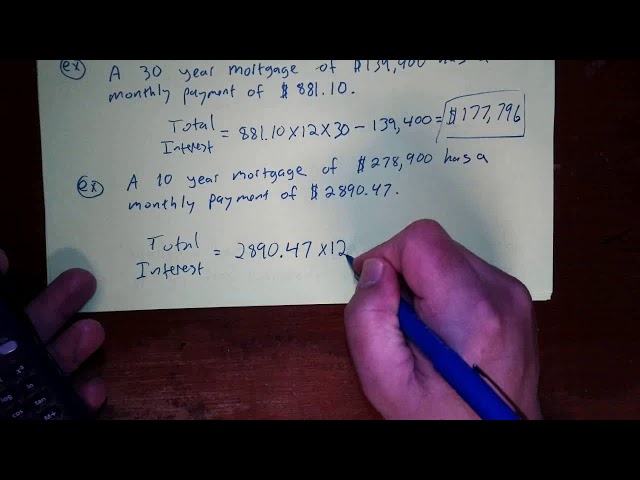
It is important to know how to calculate the total interest paid on a loan so that you can make informed decisions about the true cost of borrowing money. The total interest paid is the amount of money that you will pay over and above the amount of money that you borrowed. This includes any fees or charges associated with the loan.
To calculate the total interest paid on a loan, you will need to know the following information:
-The amount of money borrowed (the principal)
-The interest rate charged
-The length of time over which the loan will be paid back (the term)
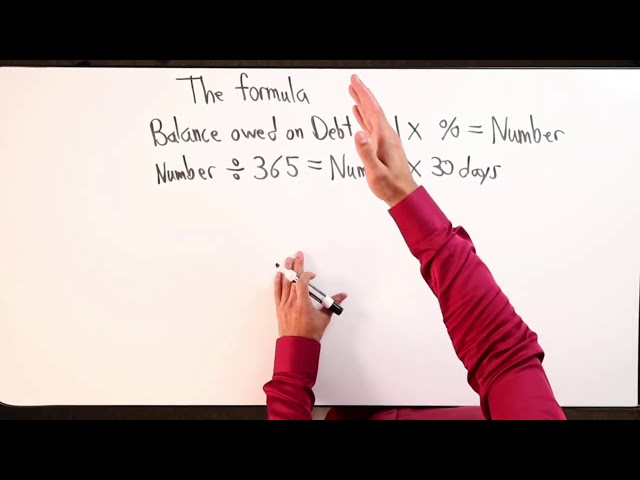
With this information, you can use a simple formula to calculate the total interest paid on a loan. The formula is:
I = P * r * t
Where:
I = Total interestpaid (in dollars)
P = Principal (in dollars) -the amount of money borrowed
r = Interest rate (as a decimal)-the annual percentage rate charged by the lender
t = Term (in years)-the length of time over which the loan will be repaid
What is simple interest?
Simple interest is a quick and easy way to calculate the interest owed on a loan, and it’s the method used to calculate most credit card interest. To calculate simple interest, you multiply the daily interest rate by the number of days that have passed since you took out the loan. For example, say you take out a $1,000 loan with a 10% annual percentage rate (APR). That’s equal to a 0.27% daily interest rate. So, if 30 days have passed since you got the loan, you’d multiply $1,000 by 0.0027 to get $2.70 in interest.
How to calculate the total interest paid on a loan
Using the formula for calculating the total interest paid on a loan, you can easily determine how much interest you will pay over the life of a loan. This information can be helpful in deciding whether or not to refinance a loan or consolidate multiple loans into one. Keep reading to learn how to calculate the total interest paid on a loan.
Find the interest rate
The first step is to find the interest rate on your loan. This can be found in your mortgage agreement or by contacting your lender.
If your loan has a variable interest rate, you’ll need to use the average interest rate over the life of the loan to calculate your total interest paid. You can find this by adding up all of the monthly interest payments and dividing by the number of payments you’ve made.
Find the principal
To calculate the total interest you’ll pay on a loan, you’ll need to know the principal, or the amount of money you’re borrowing. The principal is the total amount of money that you’re borrowing from the lender, and it doesn’t include any interest that may have accumulated. In other words, if you’re taking out a loan for $100,000, the principal is $100,000.
Find the number of payments
To calculate the total interest paid on a loan, you need to know the interest rate, the loan amount, and the number of payments. The interest rate is the percentage of the loan amount that you pay in interest. The loan amount is how much money you borrow from the lender. The number of payments is how many payments you make over the life of the loan.
To find the number of payments, divide the interest rate by 12. Then multiply that by the number of years you will be making payments. For example, if you have a 6% interest rate and you will be making payments for 5 years, your number of payments would be:
6%/12 = 0.5
0.5 x 5 = 2.5
So, you would have 2.5 years worth of payments with a 6% interest rate and a 5-year loan term.
Conclusion
In conclusion, there are a few different ways to calculate the total interest paid on a loan. The best way to do this is by using an online calculator or spreadsheet that can take into account all of the different variables involved in the loan. Additionally, it is important to remember that the total interest paid will be different for every loan depending on the interest rate, length of the loan, and other factors.