How to Get a Subsidized Loan
Contents
If you’re looking for information on how to get a subsidized loan, you’ve come to the right place. This blog post will explain everything you need to know about subsidized loans, including how to qualify and how to apply.
Checkout this video:

Introduction
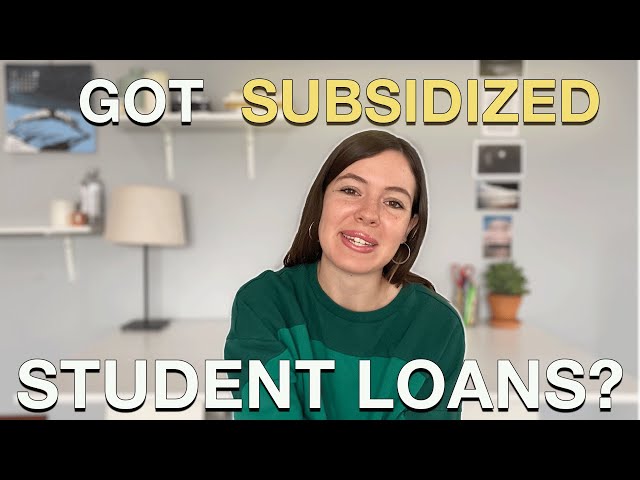
Subsidized loans are a type of financial aid that are available to eligible students attending college. The federal government pays the interest on these loans while the student is enrolled in school, during their grace period, and during any deferment periods.
To be eligible for a subsidized loan, a student must demonstrate financial need as determined by the Free Application for Federal Student Aid (FAFSA). For more information on how to fill out the FAFSA, please see our page on the topic.
There are two types of subsidized loans available to students:
-Direct Subsidized Loans: These loans are offered by the federal government and have fixed interest rates. The amount that a student can borrow is based on their financial need and other factors.
-Perkins Loans: These loans are offered by participating schools and have fixed interest rates. The amount that a student can borrow is based on their financial need and other factors.
What is a Subsidized Loan?
A subsidized loan is a loan on which the interest is reduced by an explicit or hidden subsidy. The subsidy might be a part of the interest rate, discount points or other loan fees. Or it might simply be a grant that reduces the amount you have to pay for the house.
How to Get a Subsidized Loan
A subsidized loan is a loan where the government or another organization pays the interest on the loan while the borrower is in college. The main benefit of a subsidized loan is that it can save you money on interest. If you are attending a school that is expensive, a subsidized loan can help you save money.
Who is eligible for a subsidized loan?
There are a few eligibility requirements you’ll need to meet in order to get a subsidized loan:
-You must be enrolled in an eligible degree or certificate program at least half-time
-You must be a U.S. citizen or eligible non-citizen
-You must have a valid Social Security number
-You must have financial need as determined by your school’s financial aid office
How to apply for a subsidized loan
There are a few things that you will need to have in order to apply for a subsidized loan. The first is a Social Security number. This is required in order to run a credit check. The second thing that you need is proof of U.S. citizenship or eligible non-citizenship. You will also need to have a valid email address in order to complete the online application process.
The most important requirement, however, is financial need. In order to qualify for a subsidized loan, you must demonstrate financial need as determined by the U.S. Department of Education. This means that your family’s annual income must fall below a certain level based on the size of your family and the state in which you live.
If you believe that you meet the requirements for a subsidized loan, the next step is to fill out and submit the Free Application for Federal Student Aid (FAFSA). This can be done online at fafsa.gov. Once your application has been processed, you will be notified of your eligibility for federal student aid, including subsidized loans. If you are eligible, you will then need to complete a Master Promissory Note (MPN) and Entrance Counseling session before your loan can be disbursed.
Conclusion
There are two key types of student loans: subsidized and unsubsidized. Subsidized loans are need-based, meaning that the government pays the interest that accrues on the loan while the student is enrolled in school at least half-time, during their grace period, and during deferment periods. Unsubsidized loans are not need-based, and the borrower is responsible for all interest that accrues on the loan from the time it is disbursed.
Federal Direct Subsidized Loans have a fixed interest rate of 4.53% for loans disbursed between July 1, 2019 and June 30, 2020. For new borrowers on or after July 1, 2020, the interest rate will be 5.03%. There is no origination fee for Direct Subsidized Loans.
To apply for a Direct Subsidized Loan, you must first complete the Free Application for Federal Student Aid (FAFSA). Your school’s financial aid office will then determine how much you can borrow based on your expected family contribution (EFC), cost of attendance, and other factors. You can use the loan calculator on StudentAid.gov to get an estimate of your potential loan amount.